
Self-contained breathing apparatus is reliable equipment, and most serious incidents involving it come down to how it was checked, worn and managed rather than to a technical failure. Investigations of fatal accidents return again and again to the same small set of errors. This article lists the most common ones and the habits that prevent them.
Skipping or rushing the pre-use check
The check before use takes about a minute: cylinder pressure, a high-pressure leak test, the warning signal, the lung-demand valve and the facepiece seal. Under time pressure it is tempting to shorten it, especially when the set was checked at the start of the shift. But valves can be knocked half-closed in a vehicle, a cylinder may have been swapped, and a mask can be damaged in its bag. A set that has not been checked by its wearer is not ready for use. The workshop checks described on the maintenance page do not replace the wearer's own check.
Starting with a cylinder that is not full
A cylinder that shows noticeably less than its rated pressure gives a shorter working time than the team plans for. Many services set a minimum pressure below which a set must not be committed; the German firefighting regulation FwDV 7, for example, treats sets showing less than 90 % of the nominal filling pressure as not ready for use. Change the cylinder rather than "making do".
A poor facepiece seal
Positive pressure protects against small leaks, but not against a mask that does not fit. Facial hair, sideburns or stubble along the sealing line, the arms of ordinary glasses, a hood trapped under the edge of the mask or straps tightened in the wrong order all break the seal. A wearer who needs glasses should use a spectacle kit made for the mask. A negative-pressure check (closing the inlet and inhaling) after donning shows whether the seal holds.
Not watching the gauge
The wearer — and above all the team leader — must read the pressure gauge regularly: before entry, on reaching the work area, and at agreed intervals or on prompts from entry control. Air consumption varies widely between people and with workload, so the team's working time is set by the member who uses the most air. Relying on the clock or on the warning whistle alone is a common error.
No turn-around pressure
The return trip is often slower and harder than the way in: the team may be carrying a casualty, visibility may have fallen, the route may be blocked. A common planning rule is to allow twice as much air for the way out as was used on the way in. The point at which the team must turn back should be agreed before entry, not decided when the gauge is already low.
Ignoring or silencing the warning
Some wearers have learnt to work on "just a little longer" after the warning sounds, or to carry on because a team member's whistle sounded but theirs did not. The team leaves together when the first warning in the team sounds. A whistle that fails during the pre-use check means the set is out of service.
Overexertion
Heavy work, heat, stress and poor fitness all raise breathing rate. A wearer who is breathing hard uses air two or three times faster than at rest, and in a cylinder that would last 40 minutes at light work this can mean less than 20 minutes. Pace the work, rotate teams early and plan for the effects of heat (see heat stress in protective clothing).
No buddy check
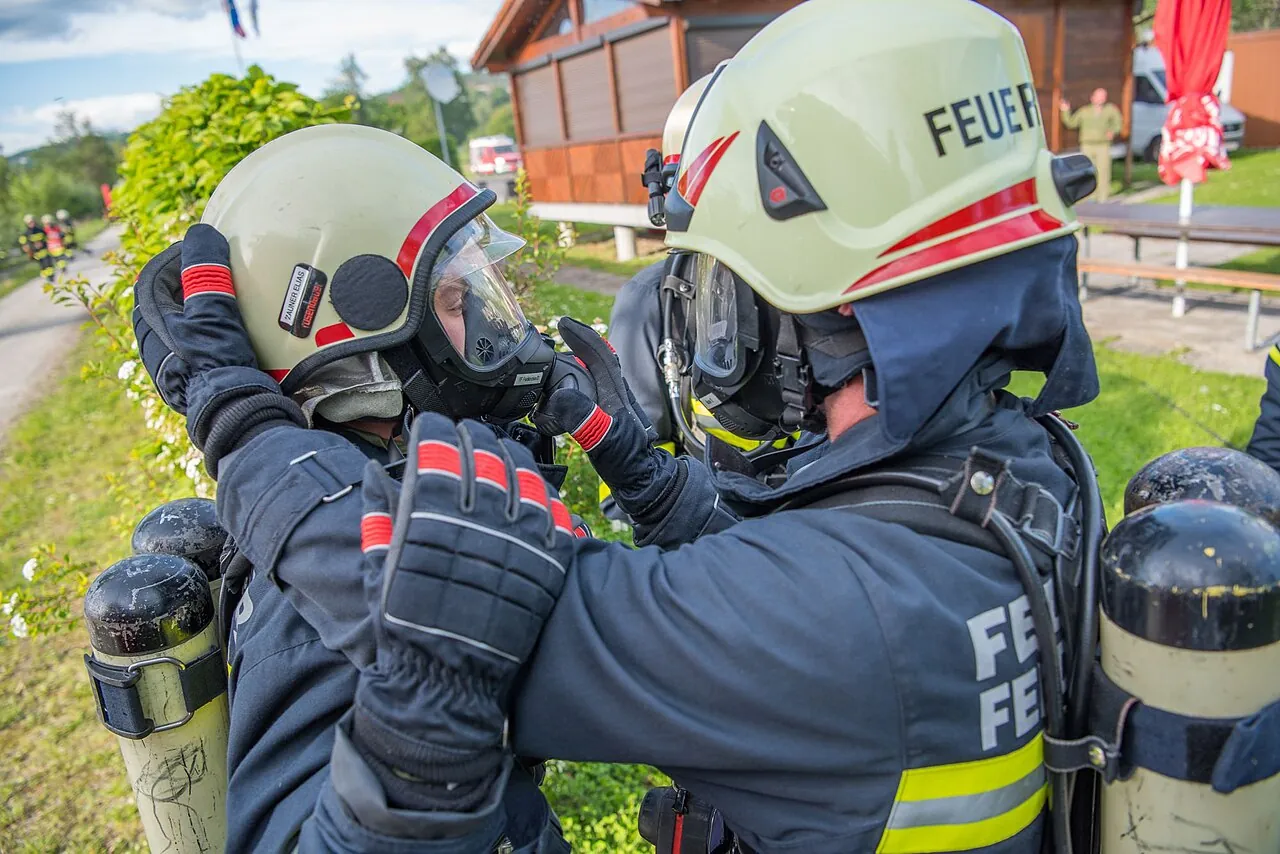
Before entry, team members check each other: cylinder valve fully open, hoses not twisted, straps and mask correctly fitted, no exposed skin, warning device and distress signal unit armed. A second pair of eyes catches mistakes that the wearer cannot see on themselves.
Removing the mask too early
Many poisonings happen after the job seems to be done: the wearer takes off the mask at the exit, in a corridor that still contains smoke or gas, or during overhaul when the fire is out but carbon monoxide remains. The mask comes off only in fresh air outside the hazard zone, or after measurements confirm that the atmosphere is safe.
Weak communication and entry control
Teams that lose contact with each other or with the entry control point are over-represented in fatal investigations. Each entry must be recorded on an entry control board — names, time of entry, starting pressure and expected time of return — and the team must report at agreed points. Contact methods and what to do when contact is lost are covered in communication in breathing apparatus teams.
What the standards cover
In Europe, open-circuit compressed-air SCBA for fire and rescue use are tested to EN 137:2006 (a revision is being drafted at CEN). In North America the SCBA requirements formerly in NFPA 1981 and the PASS requirements formerly in NFPA 1982 are now part of the consolidated NFPA 1970 (2025 edition). Standards define how the apparatus must perform; the mistakes above are about how people use it. See also standards, equipment and safety.
Sources
- NIOSH FFFIPP report F2016-07: Volunteer fire fighter dies after running out of air and becoming disoriented in retail store in strip mall fire — North Carolina
- NIOSH FFFIPP report F2013-14: Career probationary fire fighter runs out of air and dies in commercial structure fire — Michigan
- NFPA: NFPA 1970 — Standard on protective ensembles for structural and proximity firefighting, work apparel, open-circuit SCBA and PASS
- NIOSH: Fire Fighter Fatality Investigation and Prevention Program