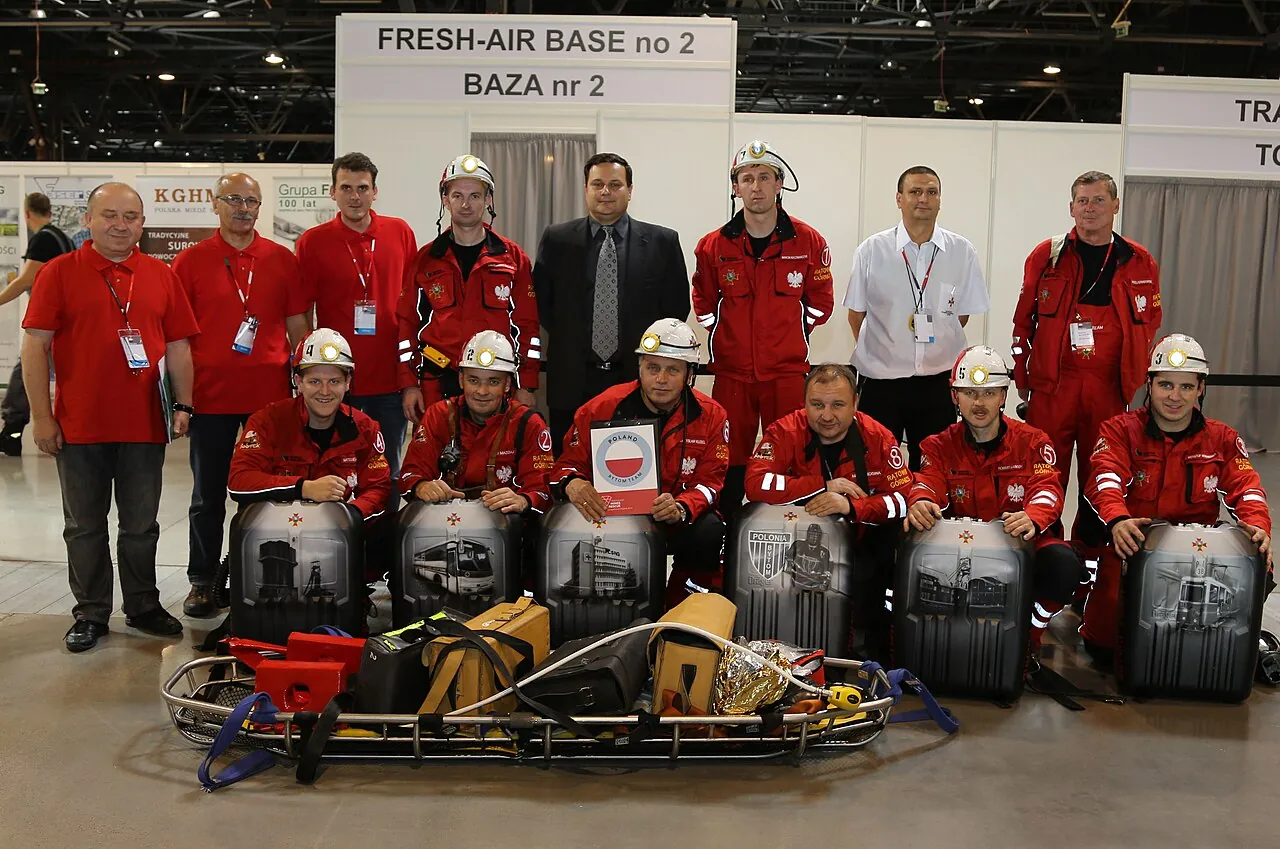
The Bytom team, winners of the 2014 International Mines Rescue Competition, with their closed-circuit breathing apparatus. Katowice, Poland, 2014. · Photo: NosProtegatBarbara · CC BY-SA 3.0 · Source: Wikimedia Commons
Gas and mine rescue depend on a network of organisations: rescue services that do the work, regulators that set the rules, research institutes that investigate accidents and test equipment, and standards bodies that define how apparatus is built and tested. This page lists the main ones, with links to their official websites.
International
Organisation
What it does
Website
International Mines Rescue Body (IMRB)
Informal association of mine rescue organisations from around the world, founded in 2001 after six rescuers died of heat stress in a Polish mine in 1998. Holds a conference every two years and shares experience and lessons from incidents.
Contest for mine rescue teams from different countries, first held in 1999 in Louisville, Kentucky, and now organised every two years with IMRB support.
UN agency for labour standards; its Safety and Health in Mines Convention, 1995 (No. 176) covers, among other things, emergency preparedness and rescue in mines.
Publishes European standards; its technical committee CEN/TC 79 deals with respiratory protective devices, including breathing apparatus for firefighting and rescue.
Develops consensus standards for the fire service; NFPA 1970 (2025) now combines the former standards on protective ensembles, SCBA (NFPA 1981) and PASS devices.
Successor of the national mines rescue service founded after the Coal Mines Act 1911; provides mine rescue cover and specialist rescue and training for other industries.
Umbrella association of the accident insurance institutions; publishes rules and information on respiratory protection and occupational medical examinations.
Accident insurance institution for the raw materials and chemical industry. Its emergency management department continues the work of the Hauptstellen für das Grubenrettungswesen, the first of which opened in 1907, and trains mine rescue and gas protection teams.
National research and safety institute for the prevention of occupational accidents and diseases; publishes guidance on confined spaces and respiratory protection and runs the CATEC certification scheme.
National Institute for Safety and Health at Work (INSST)
Government technical body for occupational safety and health; publishes technical guides and notes, including on confined spaces and respiratory protection.
Federal service for environmental, technological and nuclear supervision; supervises industrial safety at hazardous production facilities, including mines.