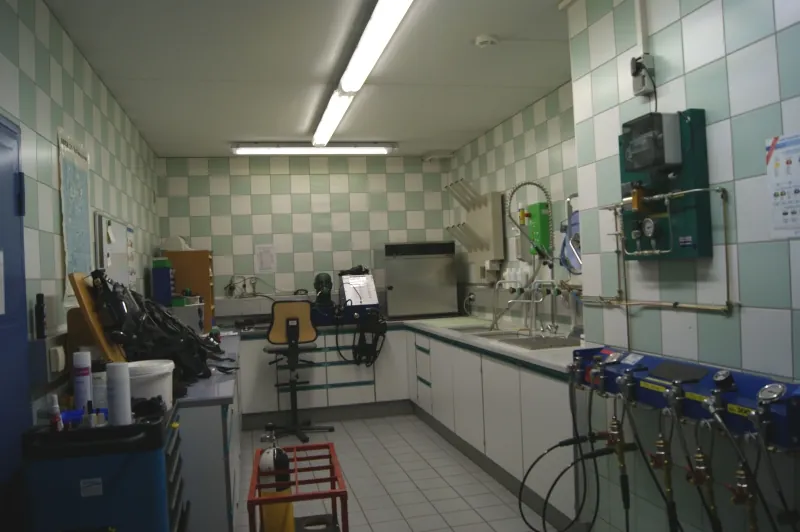

Breathing apparatus protects only if it works the moment it is needed. Every set therefore goes through a chain of checks: by the wearer before each use, by trained technicians after use and at fixed intervals, and by approved test stations for the cylinders. This page describes the general practice; the binding procedure is always the manufacturer's instructions and the national rules.
Check before use
The wearer checks their own apparatus immediately before putting it on, using a short routine learned in training and repeated every time. A typical sequence for open-circuit compressed air apparatus:
- Visual check — harness, straps, facepiece, visor, hoses and connectors undamaged and clean; cylinder secured; date of the last workshop test still valid.
- Cylinder pressure — open the valve fully and read the gauge. The cylinder must be close to full working pressure; each service sets its own minimum.
- High-pressure leak test — close the cylinder valve and watch the gauge for a set time, for example one minute. The pressure drop must stay within the limit given by the manufacturer.
- Warning signal — vent the system slowly and check that the low-pressure whistle sounds at the specified pressure.
- Facepiece seal — put on the mask and carry out a negative-pressure test: block the inlet and inhale; the mask must pull against the face and stay there. Beards, sideburns and the arms of ordinary spectacles prevent a tight seal.
- Lung-demand valve — connect it, check that air flows on the first breath, that positive pressure is maintained and that exhalation is free.
The result is recorded on the entry control board or tally together with the starting pressure. A set that fails any step is taken out of service and labelled — never "fixed" on the spot.
Cleaning and disinfection after use
After every use the facepiece and lung-demand valve are cleaned and disinfected, dried and tested again; the rest of the set is cleaned as needed. After work in contaminated areas, decontamination comes first, before the equipment reaches the workshop. Only cleaning agents and disinfectants approved by the manufacturer are used, because some chemicals damage rubber, silicone or the visor coating.
Workshop tests
Periodic tests are carried out by trained technicians on test benches that measure leak tightness, opening and closing pressures of valves, positive pressure in the mask, the response of the warning signal and the output of the pressure reducer. The intervals come from the manufacturer and from national rules. Examples:
- Germany: DGUV Regel 112-190 (November 2021) gives tables of work and intervals for each type of device — for compressed air apparatus, a visual, leak and function test after each use and every six months; for lung-demand valves and facepieces, every six months if kept on vehicles and every two years if stored in a fixed place; and a general overhaul of the lung-demand valve and the air-carrying parts every six years.
- Europe: EN 529:2005 is the European guidance document on selection, use, care and maintenance of respiratory protective devices; ISO/TS 16975-2 gives condensed international guidance on running a respiratory protection programme.
- USA: fire service SCBA are maintained under NFPA 1850, which (current edition 2026) merged the former NFPA 1851 (protective ensembles) and NFPA 1852 (SCBA) into a single standard on selection, care and maintenance.
Closed-circuit apparatus needs additional checks: the carbon dioxide absorbent, oxygen supply and dosing, and the tightness of the breathing circuit. Spare parts with a limited life, such as exhalation valve discs, diaphragms and seals, are replaced on schedule even if they look fine.
Cylinders
High-pressure cylinders are inspected and tested periodically by approved test stations: internal and external visual inspection, a check of the threads and valve, and a pressure test (usually hydraulic). The intervals are set by the transport rules for pressure receptacles (in Europe ADR packing instruction P200, in the USA 49 CFR Part 180 and the cylinder's special permit) and are stamped or labelled on the cylinder. The international standards for the procedure are ISO 11623:2023 for composite cylinders and ISO 18119:2018 for seamless steel and aluminium cylinders.
Composite cylinders may also have a limited service life. In the USA, carbon-fibre composite SCBA cylinders are normally limited to 15 years from manufacture, with extension possible only under specific special permits. Under ISO 11119 a composite cylinder can be designed either for a limited life, marked on the cylinder, or for a non-limited life (NLL). A cylinder that is out of date, has been exposed to fire or chemicals, has impact damage or cuts in the fibres is withdrawn regardless of its test date.
Breathing air
The air in the cylinders must meet EN 12021:2014 or the equivalent national standard: enough oxygen, limited carbon monoxide, carbon dioxide, oil and water content, and no smell or taste. Water is especially critical, because moisture freezes in the reducer and lung-demand valve in cold conditions and corrodes steel cylinders. Compressors are maintained to the manufacturer's schedule: filter cartridges are changed by operating hours, the air intake is placed away from engine exhaust and other sources of contamination, and the air is sampled at regular intervals.
Records
Every apparatus, facepiece, lung-demand valve and cylinder has its own record: serial number, date of manufacture, all tests and repairs, replaced parts and the technician who did the work. Records make it possible to recall equipment when a fault is found, to prove that tests were done and to see when a part reaches the end of its life.
Gas detectors
A detector is checked with test gas before each day's use (bump test) and calibrated at the intervals given by the manufacturer, after a failed bump test and after any exposure to very high concentrations, poisons or mechanical shock. Sensors have a limited life and are replaced on schedule. See bump test vs calibration and choosing a gas detector.
Escape sets
Escape hoods and self-rescuers are sealed devices that are often carried for years without being opened. They are inspected at the intervals set by the manufacturer: seals and tamper indicators intact, no damage to the case, expiry date not passed. Devices with chemical oxygen generators are withdrawn as soon as the seal is broken or the manufacturer's check criteria are not met.
Chemical protective suits
Gas-tight chemical suits (EN 943-1 in Europe) are leak-tested by inflating them to a set internal pressure and watching the pressure drop; EN 464 describes this test method. The test is done after each use and at the intervals set by the manufacturer, together with a visual check of the visor, zip, seams, gloves and boots. Suits that have been in contact with chemicals are decontaminated and checked for chemical damage before they return to service.